
The research
The evidence, and its limits.
Our understanding of the relationship between our nervous system and organizational success is new, but it's potent. Here is what it says, where it came from, and what it does not claim.
What it costs
Four numbers, one problem.
None of these are about wellbeing. They are about money, time, and what happens to a decision when the person making it has nothing left.
-
$5M
Annual cost of burnout at an average thousand-person company.
The expense is not the people who leave. It is the ones who stay and cannot think.
American Journal of Preventive Medicine, 2025 -
42%
Fall in intent to stay, attributed to change fatigue. Performance down as much as 27%.
The initiative is not failing because it was the wrong initiative. It is failing because it is the fourth one this year.
Gartner, 2023 -
70%
Of the variance in team engagement is accounted for by the manager.
This is why the work starts with one person, and why it cannot stay there.
Gallup, 2024 -
43%
Of workers with low psychological safety rate their productivity as high. Where people feel safe to speak, it is 74%.
Nobody needs telling there is a problem. It is not a training gap. It is what capable people do when it is not yet safe to tell the truth.
American Psychological Association, 2024
The findings
What the literature keeps finding.
Research is usually presented one paper at a time, which makes it impossible to see the shape of it. These are the three things the literature keeps arriving at from different directions.
-
One
Capacity goes before skill does.
Under steady pressure, the first things to fail are the ones leadership needs most. Holding detail in your head. Not saying the first thing you think. Seeing it from the other side. Keeping two competing needs in mind at once. The skill is still there. Getting to it is not. That is why a capable leader can have a bad week that looks like a character flaw and is not one.
-
Two
The team reads the leader first.
A dysregulated leader makes a guarded team. A guarded team stops raising problems early. Problems raised late cost more. That is why this work cannot be handed down the org chart.
-
Three
The cost lands on the balance sheet.
Turnover, rework, stalled initiatives, and decisions deferred past the point where they were cheap. Those are the places the expense actually appears, and none of them get filed under stress.
How it works
Regulation is the foundation.
Regulation gets your best thinking back online. That is the whole of what it does. Relational intelligence keeps people working together without the friction of tension and lack of trust. Those two feed each other, and that loop is the mechanism that creates outcomes. Radical responsibility is what keeps it turning once I have gone.
In a dysregulated team, the loop tightens.
- The load risesCapacity is exceeded.
- Access to clear thinking dropsDefensiveness increases, creative problem solving stalls.
- The hard conversation is avoidedThe problem lingers.
- The problem grows quietlyAnd arrives later, larger, as a surprise.
In a regulated team, the loop expands the capacity of the individuals, then the team.
- Regulation restores accessThe thinking that was always there comes back.
- The true thing gets said earlyWhile it is still small enough to be cheap.
- The problem stays the size it wasMultiple perspectives create a workable solution.
- The load decreasesRegulation is supported.
Regulation makes the honest conversation possible. The honest conversation lowers the load that made regulation necessary. That is why the effect does not stay with one person.
And then, radical responsibility
When taking responsibility is safe and part of the organization's culture, regulation and relational intelligence can be sustained and human potential is unleashed.
In practice
A meeting you have sat in.
Research reads as abstract until you match it to a meeting you have been in.

-
The meeting where nobody says the real thing
Everyone leaves agreeing. Nothing moves for three weeks. That gap is not a communication skills problem. It is what a team does when the cost of honesty feels higher than the cost of delay.
-
The good decision made two months late
Not because the information was missing. Because the person who had to make it did not have the capacity to take action, so it kept moving to next week's agenda.
-
The resignation that surprises everyone
They had tried to get help. Just not in a way anyone could understand.
None of this is a motivation problem. Motivated people run out of capacity too.
Let me be clear
What this does not claim.
-
It does not treat anything
This is education drawn from published research, not care. Nothing here diagnoses a condition, and nothing here is a substitute for someone who does.
-
It does not fix a broken structure
Some people are given too little, managed badly, or asked to do a job that cannot be done. No amount of nervous system work makes any of that acceptable. It only makes it survivable for longer, which is not the same thing and is sometimes worse.
-
It does not promise a number
I will not tell you this returns a specific percentage. What I will do is agree with you, at the start, which of your existing measures we are watching.
Sources
Check any of it.
- 01 American Journal of Preventive Medicine, 2025 The five million dollar figure
- 02 Gartner, 2023 Change fatigue, intent to stay and performance
- 03 Gallup, 2024 The manager's share of the variance in team engagement
- 04 American Psychological Association, 2024 Mental health and self-rated productivity
Go further
The longer version.
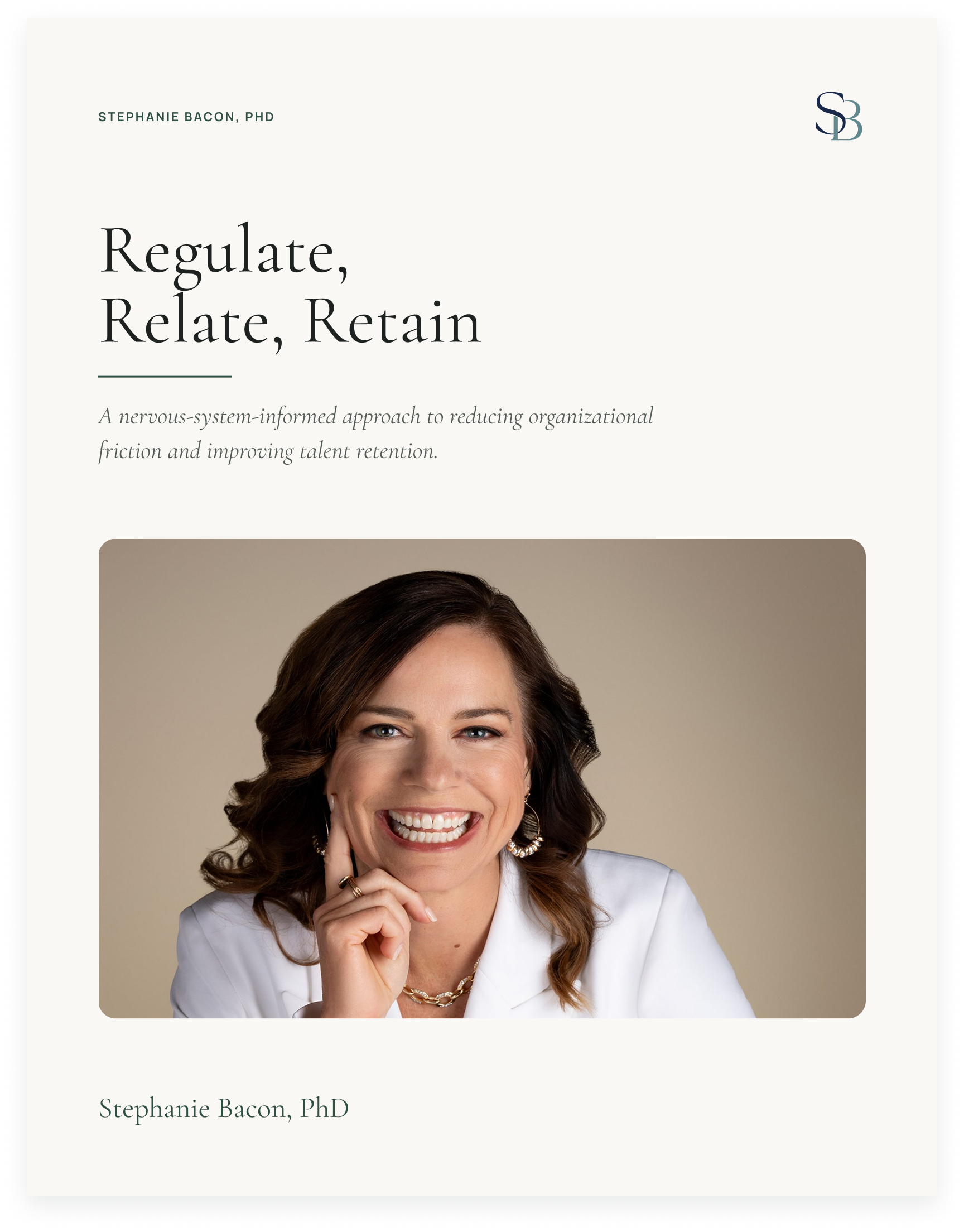
Regulate, Relate and Retain. Why people leave, what regulation changes, how relational intelligence gets built, and what retention looks like when both are in place. Twenty pages, fully sourced.
Start here
Now your own numbers.
Everything above describes the pattern in general. What it cannot tell you is how much of it is happening in your building, or what that is costing you specifically. That part takes a conversation, and it is the shortest one you will have this week.
What the research cannot tell you
- How much of this is happening in your building
- Which of your own measures are already moving
- What it is costing you this quarter, not on average